Tuesday, 8 March 2011

Production Journal

18/1/2011: In this lesson we looked over the specification to see exactly what we had to do for our Preliminary Task. This was the first time our group met together and one of the group members was absent. We wrote down a rough plan of what was to be included in the Task, like a 180 degree angle, over the shoulder shot and shot reverse shot. We then shot the whole Preliminary task in this day as we didn’t want to lose continuity.

21/1/2011: In this lesson we went to the editing suite and logged and captured the Preliminary Task onto the PC. Then we opened the application Final Cut Pro and explored it. I spent some time clicking all the buttons and searching just around it, in order to know what each button did. Just familiarising and reminding myself with how the application worked with help me deal with I whenever I came across it again.

25/1/2011: This was our two hour daytime lesson and we continued editing our Preliminary Task. After familiarising myself with the editing suite on the last lesson, this made me more confident to do more editing and do more than the basics so the Preliminary Task could look as good as possible.

26/1/2011: This was our evening session, in which we watched the final product and tweaked and put the final touches on it. We then uploaded the Preliminary Task unto our blog. After this lesson we now felt confident enough to begin to film and edit our two minute opening sequence, as the Preliminary Task was like practise and helped us deal with challenges that we would have come across during our opening sequence.

29/1/2011: This day was out of lesson hours and I decided to write for the Preliminary Task, a script to account for what was said during the filming and I also wrote an evaluation saying what is was like, what I learnt and what could have been improved if we did it again.

1/2/2011: On this Tuesday lesson Elizabeth had done the shot list for the Preliminary Task and I helped her put it in a table in Microsoft Word. I then uploaded it into ‘Scribd’ a document sharing website that allows you to post and embed documents onto web pages and uploaded to our blog.

23/2/2011: This lesson was used to brainstorm new ideas and some other ideas that we had before. We made the brainstorm on the website ‘bubbl.us’ which made it look like a spider diagram so our ideas could be clear to the audience.

4/3/2011: We wrote and uploaded our Production Brief to our blog in this lesson. This is a small account of what our two minute opening sequence will be about, who is in the group, what equipment we will need, a similar researched films and other relevant aspects concerning out film. We also filled in our Call Sheet, Props/Resources List and our Production Schedule to prepare ourselves to film the next week.

8/3/2011: This was our Tuesday two hour lesson and we used it to film the beginning of our two minute opening sequence. We did this in and around college as our movie is about a teacher so this is the perfect location for us. During the filming process I made sure when filming a shot we had extra shots of one particular shot as it will help in the editing suite and help with continuity.
9/9/2011: We continued to film our two minute opening sequence in this three hour Wednesday night class. Because it was dark it was the perfect time to film the ‘dark side’ of our movie as in the final product we aim to cut from the good sides of the teacher to the bad sides of her. We again did this inside the college and a classroom.

11/3/2011: This two hour Friday lesson we went to the editing suite to log and capture our footage to the computer, and then we would begin editing. From this day we realised that we could have a few problems on our hands, as the computer we logged and captured on is the computer we have to edit on as well. We realised that we couldn’t send the footage to our emails and open it on other computers and alter it, we also couldn’t save it on a memory stick as the whole footage was way too big. Therefore, when we wanted to use the computer to edit, it would always be occupied with students using it from other classes. This was a major issue for us as we had a lot to do and we had very little time, so to overcome this problem we had to edit out of lesson hours and in our evening classes.

15/3/2011: We worked on our individual blogs as the editing suite was occupied with students, so we talked about what type of music and titles and other effects we would use in our opening sequence when editing. We also finished some of group work that needed doing and uploaded some of the work to the group blog.

16/3/2011: On this evening night class we took out the clips we didn’t need and began to edit the beginning of our opening sequence. This took some time as we had many clips we didn’t need because we took extra shots just to be save when it came to editing 

18/3/2011 – 25/3/2011: During this week we used all this time to edit our opening sequence as this is a very long process. By the end of the week we had finished our first draft of the opening sequence, but we weren’t able to upload it to blog due to technical problems. We decided to leave this till Monday when we would also be making changes to the first draft to make it the final draft. We knew the changes we needed to make so it was just the case of finalising a few things before uploading the final and completed draft to the blog.

Friday, 25 February 2011

Synopsis for Opening Sequence ‘The Teacher’

This two minute opening sequence is about the dark and twisted side of a teacher who has two very different personalities, as by day she teaches at her college but by night is a cold hearted killed. The audience is left questioning the film as we use fast paced cuts between the good and bad sides of her.

We see a teacher going about her daily routine in Havering College; she walks into the building and goes through the barriers by swiping her ID card. Minding her own business looking content she walks up the two flights of stairs and through the empty corridors to her classroom.

In the classroom she now grabs her notebook and sits as her desk and goes through it, as she does this she is interrupted by one of her students who has come to see for some help. The student explains to her that she confused and doesn’t understand what was said in today’s lesson. As the students sits down the teacher looking confused asks her what exactly she didn’t understand as the things she went over were fairly simple. Continuing to plead and beg the teacher to understand that she really needs help, we then see the teachers dark and nasty side as she tell the student that unfortunately she can’t be of any help to her, while doing this she slams her pen on her table and leans forward, urging the student to leave. The student gets up looking shocked yet confused and leaves the classroom. A knife with blood being wiped of is what we see next and an unknown person admiring it.

We then see an unidentified person walking up a different flight of stairs heading to a classroom in the college. When they arrive at the classroom we see the same student from earlier on, on a computer. As they turn round they look scared and frightened to see this mystery person that hasn’t yet been revealed to the audience. The person walks into the classroom then shuts the door. We then see the student lying on the floor as this mystery person hovers over the body and walks round to the front of the body and kneeling down pulls down their hood down and looks up revealing their identity as the teacher.

Monday, 14 February 2011

Codes and Conventions of Opening Sequences

The opening of most movies usually begin with distribution and production logos of the companies that help to shape and put the movie together as a whole. For example, for the movie ‘Along Came a Spider’ we see the logo which is a mountain with stars around it then the name of the company Paramount across the middle. Sometimes logos and such can be edited in order to reflect the story line of a film and appeal to the audience more. However, this all comes down to the budget of the film and if the public and audience have high expectations for the film.

After all the productions logos and such we usually them see titles of the film, firstly with the main stars or maybe the director if the director is of important significance. We will see the titles of the film on a blank dark screen or included within the film and just fading in and out as it continues to play. On the other hand, some directors prefer to use establishing shots to give the audience an insight and a small hint of what the film may be about and where it is being set. Here we see an establishing shot within the movie ‘The Shawshank Redemption, we see a shot of the prison, some cars and then cutting to the main character Andy on a bus as it rolls through the gates.

Some movies revolve around the actors as if it’s someone really famous and a well known good actor they will be the focus of the movie. Star based movie as becoming common and directors use this to draw in their audience as they know that if a certain actor is in a movie they’re more likely to watch it. We can notice this on movies such as ‘Armageddon’ starring the well known actor Bruce Willis and another movie ‘New Moon’ from the Twilight Saga starring the hunky chiselled Robert Patterson. 

Overall, as we know not all movies are the same and they all vary due to their specific genre, theme and ultimately on the director and they have a personal vision on what they want the movie to be like. Some movies will get the audience’s attention by calling it a ‘teen flick’ if appealing to teenager or ‘outrageously funny’ if appealing to people who are into comedies, every movie varies. There is not a set particular order that a movie has to conform to or follow as their target audiences and goals are different.  

Saturday, 5 February 2011

‘Along Came A Spider’ Opening Sequence Analysis

After researching into the ‘Se7en’ opening sequence it’s given us some ideas as to what we want out actual thriller to be like. However, just to give us more of an insight into some things we may like to include in our film I researched the film ‘Along Came a Spider’.

 This is about a congressman’s daughter under Secret Service protection, who is kidnapped from a private school by an insider who calls Det. Alex Cross, sucking him into the case even though he’s recovering from the loss of his partner. The main stars include the protagonist Morgan Freeman, Michael Wincott and Monica Potter as the antagonists’. This film could be classed as a mystery Thriller as it contains the codes and conventions of a typical Thriller. The director conveys themes of a Thriller by using sound, editing, camerawork, cinematography and mise-en-scene to create suspense, tension and enigmas to the audience.

Within the first twenty seconds of the sequence we see the titles of the film appear and we can notice the name ‘Along Came a Spider’ connects with the title being shown as the letter ‘A’ repeatedly comes down on a web to create words of the titles. This gives the movie an edge and also an eerie affect and this is mainly used to reflect the storyline of the film. In the background we can also notice something that looks like police lights flashing so this immediately makes the audience ask some question like; what is going on and what is going to happen?


While the titles appear we hear some diegetic music as a man and a woman talk but we don’t see them. This contrapuntal sound is crucial to the audience as they see titles and flashing lights but they don’t see anyone which creates enigmas as anything could happen at any time.  Also, while they’re talking we hear some non-diegetic music which is just some background music to accompany the film and reinforce the theme of a Thriller. The music changes pitch and tone quickly and slowly begins to grow faster.

We then see an establishing shot of a car on the road and a helicopter coming onto the screen and then the movie continues. This film is a conventional Thriller as it creates suspense and enigmas by using slow paced cuts and eerie music all for the audience’s expectations to be risen. However, it may be seen as not being a typical Thriller as we don’t see any people so the audience is hidden in the dark for quite a while. 

Tuesday, 1 February 2011

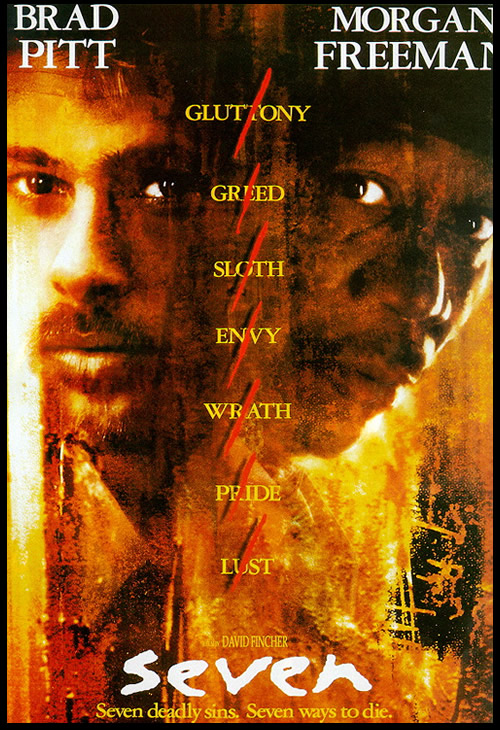
'Se7en’ Opening Sequence Analysis

Researching into some opening sequences will help give me a more of an idea of what our group would like to include in our Thriller opening sequence. I’m analysing the Thriller film ‘Se7en’ made in 1995 with the director David Fincher and writer Andrew Kevin Walker. Stars in this all time Crime Thriller include Morgan Freeman, Brad Pitt and Kevin Spacey.  The plot is mainly two detectives, a rookie and a veteran; hunt a serial killer who uses the seven deadly sins as his modus operandi.

The ‘Se7en’ opening sequence is short yet effective as it uses fast paced cuts which gives the audience little glimpses of ultimately what the story is about. The editing gives the film typical generic convections as there are close ups and the shots are quite fast which gives it the overall eerie atmosphere for the film. Also, the transitions between the shots are a black screen that’s when the titles are shown; this helps the audience digest what they’ve just seen before seeing something else. The fonts of the titles are also typical of a Thriller genre as it’s a serif font and its slanted which suggest instability.

The sound plays a big part in every film as it helps set the atmosphere and express and convey emotions. In this film in particular, parallel sound is used as we see an unknown character scraping the skin of a finger with a razor blade and the music complements this as it has a sketchy sound. The pace  and pitch of the music gets faster as the sequence moves towards the climax, this will create enigmas in the audience as they anticipate something is going to happen.

The director uses mise-en-scene to convey the Thriller theme to the audience. He does this by the use of lighting and colour. There are harsh colours being used like different shades of grey and black and hard lighting. This is also typical of the Thriller genre as it sets the scene and mood. The setting is rather hidden from the audience as the angles that are mainly used are close ups so we don’t get an ultimate establishing shot which will reveal more about the narrative. But from what we can see the setting connects with the music and whole theme of the film.